
Continuous Delivery vs Continuous Deployment are distinguished by exactly one pipeline decision: the production release step. In **continuous delivery**, every validated change is proven deployable bu…
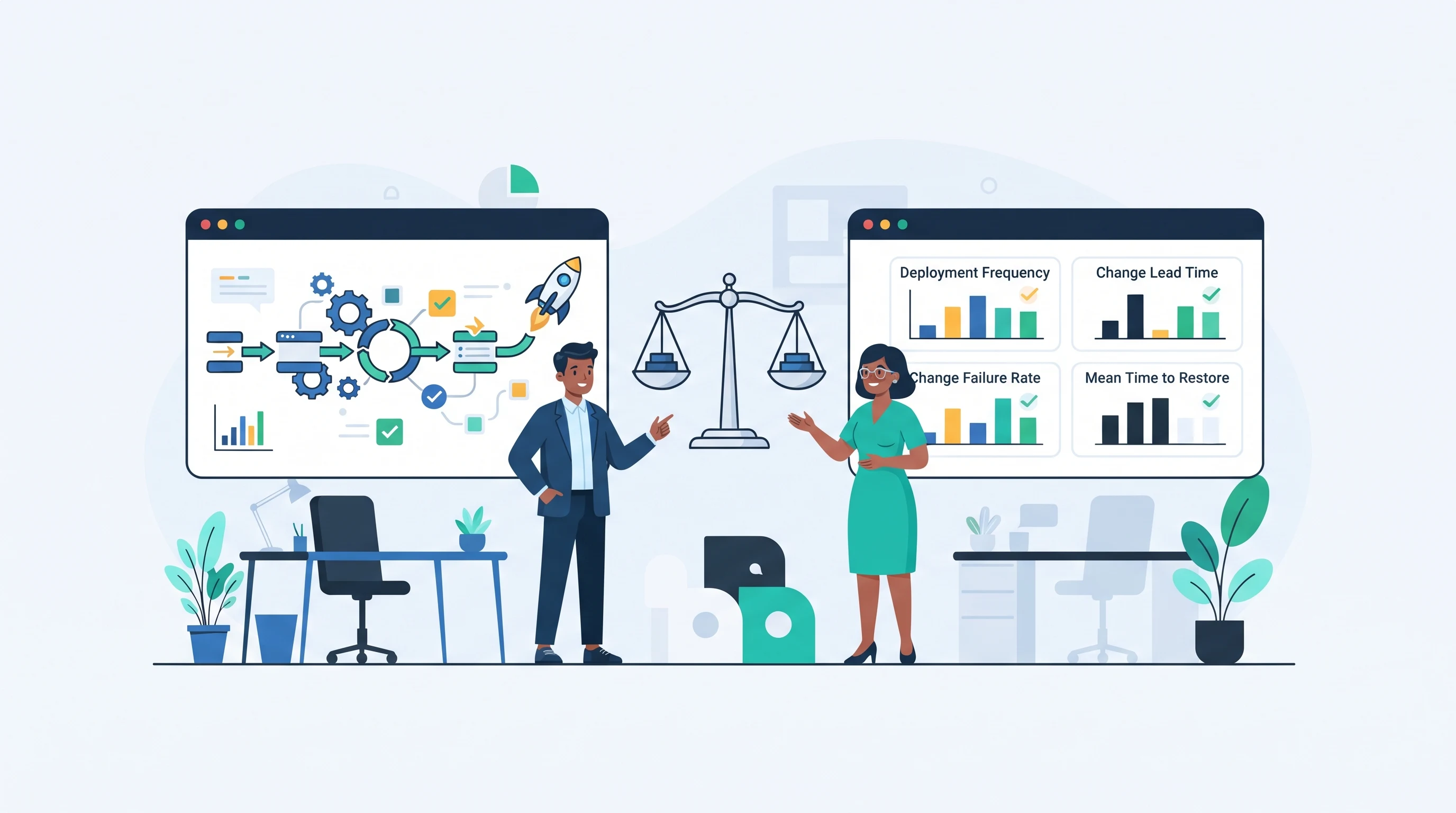
Continuous Delivery vs Continuous Deployment are distinguished by exactly one pipeline decision: the production release step. In continuous delivery, every validated change is proven deployable but the final push to the production instance requires a manual trigger or business approval; in continuous deployment, that final step is fully automatic, sending changes straight to users. Organizations implement continuous delivery first and advance to continuous deployment only after gaining sufficient DevOps maturity, deep automation confidence, and rapid recovery capabilities.
In Short
What Is Continuous Delivery?
Continuous delivery is a DevOps practice where code changes are automatically built, tested, and prepared for release to production, yet the final deployment to the production instance stops at a manual gate. The pipeline continuously proves that the software is in a deployable state, but a human decision—or a formal approval structure—determines when it actually goes live.
Organizations that need to keep total control of their production environment through formal approvals and visibility tend to opt for continuous delivery. Banking and other financial segments often fall into this category because regulatory obligations, current service levels, license agreements, or the overhead and disruption of deployment make automatic releases undesirable.
A key architectural advantage of this model is that planning and releasing activities are decoupled. The business can choose to release on demand—hourly, daily, weekly, or less frequently—without the technical team needing to rebuild or repackage the software each time.
Achieving this state is not simply a matter of tools. It is an outcome based on deep thinking and maturity of the organization in running DevOps and automation. It also requires an efficient continuous delivery pipeline and an architecture that supports incremental delivery practices.
What Is Continuous Deployment?
Continuous deployment extends the pipeline one step further: any change that passes all automated validations is automatically released to the production environment without a manual trigger. There is no business approval gate; the final sequence that deploys to the production instance is fully automated.
Any organization on a journey of implementing DevOps will implement the continuous delivery process and, upon gaining sufficient maturity, will move toward the pinnacle of DevOps maturity: the continuous deployment process. This stage represents the point where the organization trusts its automation, testing, and monitoring enough to eliminate the human veto entirely.
Organizations that have scaled the DevOps maturity ladder are quite confident that automatic deployment does not cause significant impact to their production environment. Even if something fails, the rollback is rapid—often before anybody can notice it. Companies like Amazon, Netflix, and Google have operated in this space for years.
Because every successful change goes straight to users, this model demands not only an efficient continuous delivery pipeline but also robust architectural support for incremental delivery and immediate recovery.
Continuous Delivery vs. Continuous Deployment: At a Glance
| Aspect | Continuous Delivery | Continuous Deployment |
|---|---|---|
| Production Release Trigger | Manual approval or business decision | Fully automatic upon passing validation |
| DevOps Maturity Level | Foundational to intermediate | Pinnacle / advanced maturity |
| Typical Organizational Fit | Banking, finance, regulated industries | Amazon, Netflix, Google, high-velocity SaaS |
| Risk and Governance Model | Formal structure of approvals and visibility | Automated governance; rapid rollback assumed |
| Planning vs. Releasing | Decoupled; release on demand | Every validated change is released immediately |
| Required Capabilities | Efficient pipeline, incremental delivery architecture | Deep automation maturity and operational confidence |
The progression from continuous delivery to continuous deployment is not a tool upgrade; it is a maturity journey. Getting continuous delivery to work is itself an outcome based on deep thinking and maturity of the organization in running DevOps and automation.
Teams must first prove they can keep the mainline in a consistently deployable state, handle tiny changes safely, and recover quickly. Only after demonstrating that automatic deployment would not cause significant impact—and that rollback is rapid—should they remove the manual production gate. Skipping this maturity curve and automating production releases too early creates the exact disruption and overhead that the manual gate was designed to prevent.
How to Assess and Advance It in Practice
Follow these concrete steps to evaluate your current state and progress responsibly:
Key Takeaways
Frequently Asked Questions
What is the main difference between continuous delivery and continuous deployment?
The difference lies in the final sequence to production. Continuous deployment automatically deploys validated changes to the production instance, while continuous delivery requires a manual trigger or approval for that same step.
Which should an organization implement first?
Organizations on a DevOps journey should implement continuous delivery first. Only upon gaining sufficient maturity in automation, testing, and operational recovery should they move toward continuous deployment, which is the pinnacle of DevOps maturity.
Is continuous deployment suitable for banking and financial services?
Typically no. Organizations that need total control of the production environment through a formal structure of approvals and visibility tend to opt for continuous delivery. Banking and other financial segments usually fall into this category.
What capabilities are required for frequent releases in either model?
Both require DevOps capabilities, an efficient continuous delivery pipeline, and an architecture that supports incremental delivery practices. Achieving this is an outcome based on deep thinking and maturity in running DevOps and automation.
What does "release on demand" mean?
It means planning and releasing activities are decoupled. The technical team maintains deployable software at all times, while the business decides when to trigger the release based on service levels, license agreements, or operational readiness.
Why do some organizations never move from continuous delivery to continuous deployment?
For some enterprises, automatic deployment is not desirable due to the overhead and disruption of deployment, specific service levels, or the need for formal governance. Continuous delivery already provides significant value by ensuring changes are always in a deployable state.
Conclusion
Choosing between continuous delivery and continuous deployment is not about picking the "better" technology—it is about matching your release automation to your organization's maturity, architecture, and risk governance. Start with a manual-gated continuous delivery pipeline, prove your ability to recover instantly, and advance to full automation only when the business is truly ready. To find out exactly where your organization stands today, take MaturaScore's free maturity diagnostic to assess your current state and receive an AI-assisted, human-validated action plan.