
ITIL and DevOps are not opposing forces but complementary disciplines that together define modern IT service management. While DevOps focuses on shortening lead times and increasing deployment frequen…
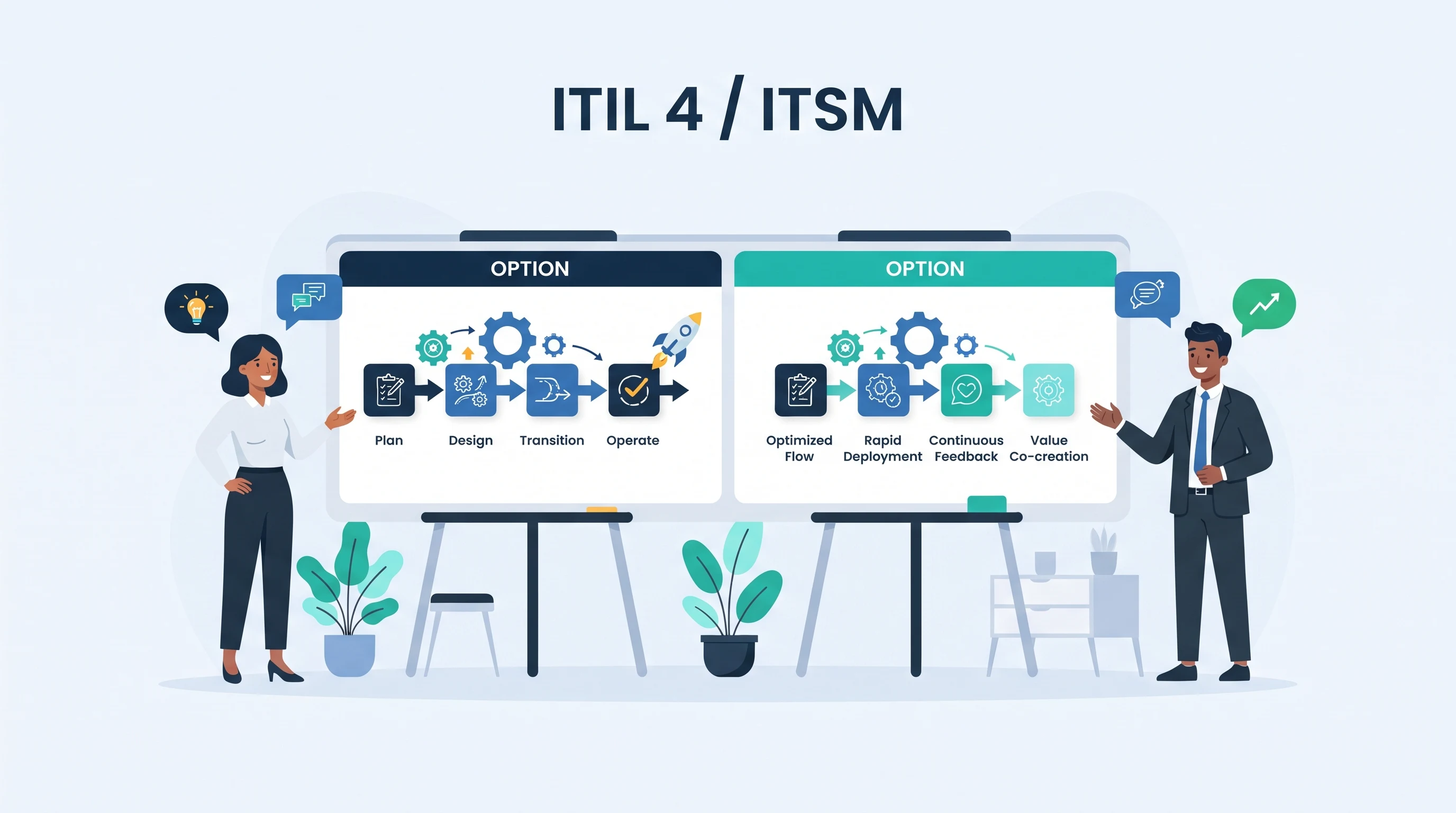
ITIL and DevOps are not opposing forces but complementary disciplines that together define modern IT service management. While DevOps focuses on shortening lead times and increasing deployment frequency through cultural and technical practices, ITIL 4 provides an ever-evolving governance framework that explicitly embraces automation and optimization to enable those very outcomes. Organizations that integrate both gain the operational speed of DevOps without sacrificing the strategic oversight, risk management, and service quality that mature ITIL processes deliver.
In Short
What ITIL 4 and DevOps Actually Deliver
ITIL 4: Governance That Evolves
ITIL is best understood as an ever-evolving library of practices intended to codify the processes that underpin world-class IT operations. Its scope spans service strategy, service design, service transition, and service support, giving organizations a common language for managing the full lifecycle of technology services. A core principle of the framework is the liberty it gives service architects to design an approach that fits their organization rather than forcing a rigid, one-size-fits-all model.
With ITIL 4, this adaptability reached a new level. The framework introduced guiding principles that explicitly couple optimization and automation, allowing ITIL to step through DevOps doors without losing its structural integrity or its focus on value. Rather than treating automation as an external add-on, ITIL 4 builds it into the foundation of service management.
DevOps: Velocity Through Culture and Technical Practice
DevOps is a multidisciplinary movement that breaks down silos between development and operations to enable shorter lead times and higher deployment frequencies. It emphasizes continuous integration, automated testing, infrastructure as code, and rapid feedback loops. Where traditional, manual interpretations of service management were seen as bottlenecks, DevOps seeks to remove handoffs and accelerate the flow of value from commit to production.
It is not a replacement for operations governance but a mechanism for executing operations work at speed.
The Convergence Point
The overlap between ITIL 4 and DevOps is deliberate, not accidental. ITIL 4 acknowledges that modern service management cannot rely on manual checks alone in an era of continuous delivery. By embedding optimization and automation into its core guidance, ITIL 4 creates a native interface with DevOps pipelines. The result is a structure where governance does not block speed but is enforced through automated controls, policy-as-code, and streamlined release pathways. The framework provides the what and why; DevOps provides the how and how fast.
Why the ITIL vs DevOps Debate Misses the Point
The perception that DevOps is a backlash against ITIL is a persistent myth. Many practitioners view ITIL as inherently incompatible with rapid release cycles because they associate the framework with heavy, document-driven change advisory boards and bureaucratic gatekeeping. In reality, DevOps practices can be made compatible with ITIL processes. The friction was never about the framework’s intent but about the manual, antiquated execution of its processes in organizations that had not updated their operating models.
Before ITIL 4, bridging this gap required significant customization. Practitioners had to tweak ITIL V3 heavily to fit DevOps contexts, refitting organizational structures and rethinking most ITIL processes for continuous delivery modes. Early adaptations placed special emphasis on employing technology and automation to increase efficiency and reduce defects. Many of these custom tweaks have since been absorbed into ITIL 4. The framework now blends these modern requirements seamlessly, meaning organizations no longer need to reinvent ITIL to work in the age of DevOps.
When ITIL processes such as configuration management and release management are fully automated, they solve many of the problems historically associated with ITIL speed. Automated change validation, continuous compliance checks, and self-service provisioning transform ITIL controls from speed bumps into guardrails. The framework still ensures that services are designed, delivered, and supported according to organizational risk appetite; DevOps simply executes those requirements at a velocity that manual methods cannot match.
| Dimension | Myth: ITIL Blocks DevOps | Reality: ITIL 4 Enables DevOps |
|---|---|---|
| Core Relationship | ITIL is a legacy inhibitor that DevOps replaces | ITIL is an ever-evolving practice library that codifies world-class operations |
| Speed of Delivery | Change management inherently slows deployments | Automated ITIL processes support shorter lead times and higher deployment frequencies |
| Automation Role | ITIL relies on manual approvals and paperwork | ITIL 4’s guiding principles couple optimization and automation natively |
| Organizational Fit | Rigid, one-size-fits-all framework | Service architects have liberty to design ITIL to fit the organization’s DevOps model |
| Operations Focus | ITIL is irrelevant to modern software development | Most ITIL-based roles sit in service operations—the stable foundation that DevOps depends on |
Integrating these frameworks is not about choosing sides; it is about aligning governance with execution. Follow these concrete steps:
Key Takeaways
Frequently Asked Questions
Is ITIL 4 outdated in a DevOps world?
No. ITIL is an ever-evolving library of practices, and ITIL 4 explicitly incorporates automation and optimization to align with modern delivery methods. It was designed to adapt to fast-moving environments rather than resist them, and many adjustments that practitioners once had to invent for earlier versions are now standard.Can ITIL and DevOps really work together?
Yes. DevOps and ITIL are not mutually exclusive. DevOps practices can be made compatible with ITIL processes, especially when configuration management, release management, and other control points are automated to support shorter lead times and higher deployment frequencies.Does adopting DevOps mean we can drop ITIL?
No. DevOps accelerates delivery, but ITIL provides essential governance across service strategy, design, and support. Most ITIL-based jobs are in service operations, which remains the critical backbone for reliable, scalable delivery that DevOps alone does not replace.What changed in ITIL 4 to make it DevOps-friendly?
ITIL 4 introduced guiding principles that couple optimization and automation, giving service architects the liberty to design frameworks that fit their organization. The tweaks and customizations that were previously necessary to adapt ITIL V3 for DevOps have been blended seamlessly into the current framework.Do DevOps teams need ITIL certification?
A solid understanding of the operations side of IT is highly valuable. The ITIL Foundation certification is considered adequate for service operations roles and ensures that teams share aligned processes, terminology, and ways of working, which reduces friction in cross-functional teams.Which ITIL processes should we automate first for DevOps?
Start with configuration management and release management. Automating these areas supports the shorter lead times and higher deployment frequencies associated with DevOps while preserving the control, traceability, and risk management that ITIL demands.Conclusion
The ITIL vs DevOps question is built on a false dichotomy. When ITIL 4 is treated as an adaptable governance layer and DevOps as the delivery engine, organizations achieve both speed and control without compromise. Curious about your current maturity? Take MaturaScore’s free maturity diagnostic to assess where you stand and get an AI-assisted, human-validated action plan for your service management evolution.