
The Project Management Body of Knowledge (PMBOK) 7th Edition redefines project management as a value-delivery system anchored by 12 principles and executed through 8 integrated project performance dom…
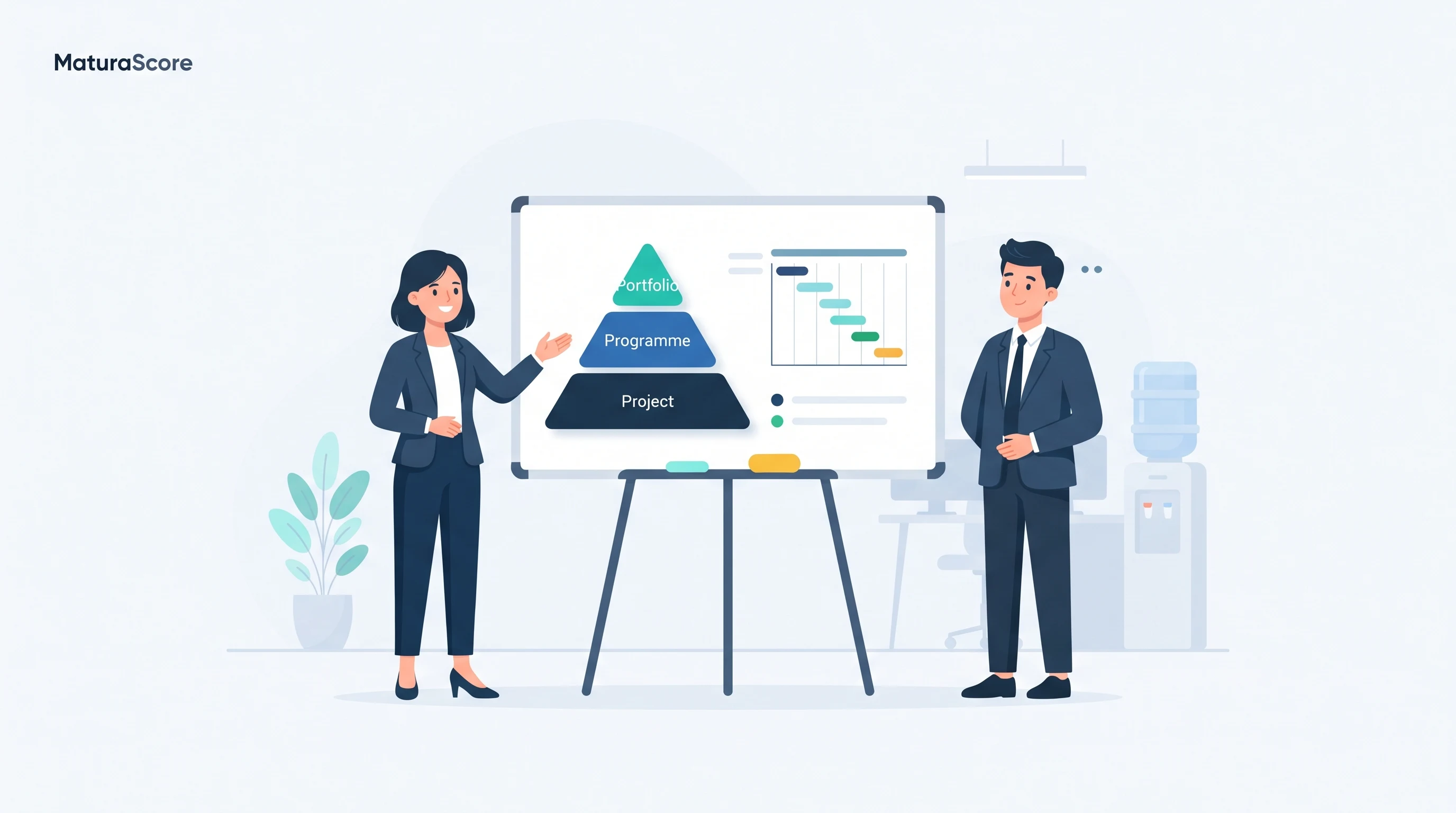
The Project Management Body of Knowledge (PMBOK) 7th Edition redefines project management as a value-delivery system anchored by 12 principles and executed through 8 integrated project performance domains. Instead of prescribing rigid process groups, the guide provides PMP practitioners and P3M3 assessors with a flexible foundation for tailoring models, methods, and artifacts to the unique context of each project. Mastering how the principles guide decisions across the domains—and how both align with organizational maturity—is now central to effective project leadership.
In Short
The 12 Principles and 8 Performance Domains Defined
PMBOK 7 is organized around two core constructs: principles that shape mindset and behavior, and performance domains that describe the critical activities required to produce value.
The 12 Project Management Principles
These principles are universal norms that apply regardless of delivery approach—predictive, adaptive, or hybrid:
The 8 Project Performance Domains
According to the PMBOK Guide—Seventh Edition, these domains form an integrated system to enable successful delivery of the project and intended outcomes. They are not sequential phases; they overlap and interact throughout the life cycle.
| Performance Domain | Core Focus | Why It Matters |
|---|---|---|
| Stakeholder | Engagement, communication, expectation management | Ensures alignment and sustained support |
| Team | Culture, leadership, team performance | Creates the environment for high performance |
| Development Approach and Life Cycle | Predictive, adaptive, or hybrid methods | Matches delivery rhythm to risk and uncertainty |
| Planning | Estimation, scheduling, priorities | Produces an evolving, actionable roadmap |
| Project Work | Processes, tools, vendor/contract management | Enables efficient execution and value stream flow |
| Delivery | Scope, quality, release of value | Realizes the intended outcomes for stakeholders |
| Measurement | KPIs, baseline variance, forecasting | Supports evidence-based decisions and transparency |
| Uncertainty | Risk, ambiguity, complexity | Builds resilience and optionality into the plan |
Principles provide the why; performance domains provide the what; and tailoring plus models, methods, and artifacts provide the how.
According to the standard, the eight project performance domains form an integrated system to enable successful delivery of the project and intended outcomes. This means a decision in the Uncertainty domain—such as hedging a supplier risk—directly influences the Planning domain (contingency reserves), the Project Work domain (contract terms), and the Measurement domain (risk-adjusted forecasts).
The guide also presents a range of models, methods, and artifacts that illustrate the options project teams can use to produce deliverables, organize work, and enable communication and collaboration. These are not mandatory templates; they are a curated toolbox selected through tailoring.
For organizations pursuing P3M3 maturity improvement, this structure is particularly useful. P3M3 assesses how consistently capabilities are deployed across portfolios, programmes, and projects. PMBOK 7’s principles can serve as the behavioral standards for P3M3’s people and management perspectives, while the eight domains provide a ready-made capability taxonomy for the process perspective. As teams move from managed to defined and optimized maturity, PMBOK 7 offers the common language and practices needed to standardize performance without sacrificing context-specific adaptation.
How to Apply PMBOK 7 in Practice
Key Takeaways
Frequently Asked Questions
What are the 12 principles in PMBOK 7?
They are stewardship, team collaboration, stakeholder engagement, value focus, systems thinking, leadership, tailoring, quality, complexity navigation, risk optimization, adaptability, and enabling change. Together they form the ethical and strategic foundation for all project decisions.What are the 8 performance domains in PMBOK 7?
They are Stakeholder, Team, Development Approach and Life Cycle, Planning, Project Work, Delivery, Measurement, and Uncertainty. These domains describe the key activities that integrate to deliver project outcomes.Why did PMI replace Knowledge Areas with Performance Domains?
The shift reflects modern project management practice where outcomes, stakeholder value, and adaptability matter more than rigid process compliance. Performance domains better represent how projects actually operate as integrated systems rather than isolated knowledge silos.How does tailoring work in PMBOK 7?
Tailoring is the intentional adaptation of the project’s methods, governance, models, and artifacts to fit the specific context, complexity, and stakeholder needs of the initiative. The guide dedicates a full section to what should be tailored and how to carry it out.What is the relationship between PMBOK 7 and P3M3?
PMBOK 7 provides the underlying practices, principles, and domain definitions that organizations can standardize to improve maturity. P3M3 evaluates how consistently these capabilities are deployed across portfolios, programmes, and projects.How do the principles and domains interact during a project?
Principles guide behavior and decision-making across all domains. For example, the principle “focus on value” shapes how the Delivery domain defines scope, how the Measurement domain selects KPIs, and how the Stakeholder domain prioritizes engagement efforts.Conclusion
PMBOK 7 offers a modern, principle-driven architecture for delivering value in complex environments. By mastering the 12 principles and 8 performance domains—and tailoring them to your organizational reality—you move beyond process compliance toward genuine project excellence. If you want to know where your organization stands today, try MaturaScore’s free maturity diagnostic to assess your current capabilities and receive an AI-assisted, human-validated action plan for improvement.