
DevOps, Agile, and ITIL are not competing methodologies but complementary layers of modern IT delivery: Agile governs how software is built iteratively, ITIL governs how services are operated reliably…
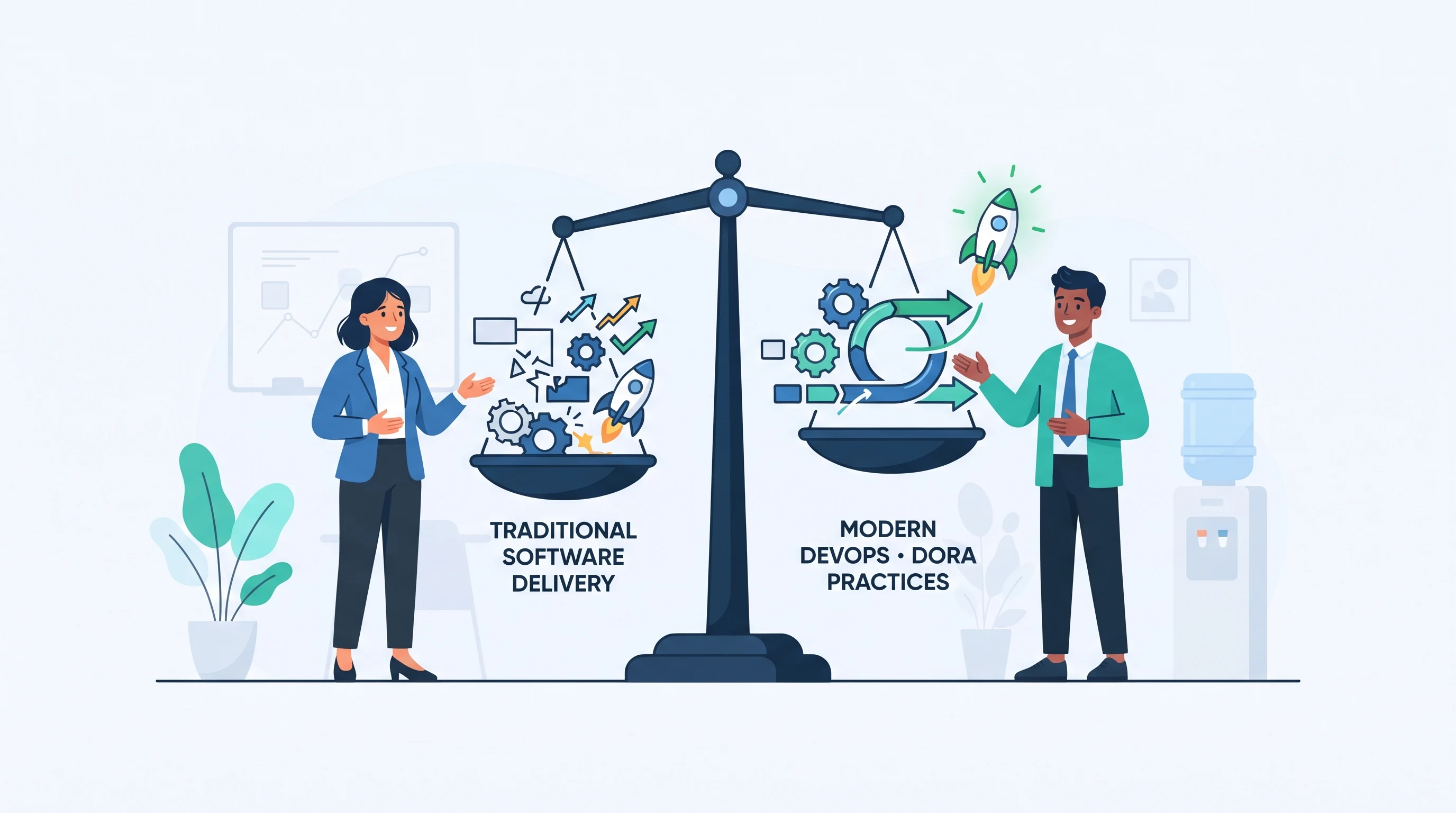
DevOps, Agile, and ITIL are not competing methodologies but complementary layers of modern IT delivery: Agile governs how software is built iteratively, ITIL governs how services are operated reliably, and DevOps is the overarching culture and practice that unifies both under a single set of principles. Rather than forcing a false choice between speed and stability, high-performing organizations use Agile for development workflows, ITIL for operational discipline, and DevOps to bridge the two into a continuous value stream.
In Short
What Each Framework Actually Covers
Agile: Iterative Development
Agile emerged to replace the rigidity of waterfall planning with flexibility and dynamism. Its core promise is to generate value by meeting changing customer needs through small teams that deliver high-quality code in short iterations. Agile remains an effective enabler of DevOps because it keeps development teams focused on customer-centric outcomes and continuous feedback.ITIL: Service Operations Discipline
ITIL, with origins in IT service management dating back to 1989, provides a structured approach to managing the operational lifecycle. It defines how to handle incidents, problems, changes, configurations, and releases in a way that preserves service availability and customer value. For many years, ITIL was criticized as bureaucratic and inflexible, but ITIL 4 has reframed it around a wider practice-based perspective.DevOps: The Unifying Superset
DevOps bridges the gap that Agile alone could not close. While Agile existed mainly to end the rigidity of waterfall development, applying the same methodology to operations without an overarching framework proved difficult. DevOps solves this by bringing operational phases and development activities under a single umbrella. It is not just automation; it is a shared culture, a set of technical practices, and a systems-thinking mindset that applies common principles across the entire software lifecycle.From Agile to DevOps: Extending the Journey
DevOps is widely viewed as the logical continuation of the Agile journey that began in 2001. Agile practices naturally evolve into DevOps practices when teams extend their goal beyond “potentially shippable code” at the end of each sprint. In mature DevOps teams, code is always in a deployable state, developers check into trunk daily, and features are demonstrated in production-like environments. This extension preserves Agile’s emphasis on small teams and customer collaboration while adding the operational rigor needed to run services at scale.
ITIL and DevOps: Compatibility, Not Conflict
A persistent myth holds that DevOps is a backlash against ITIL and that the two cannot coexist. This is false. In practice, development processes are managed through Agile, while operations are governed through ITIL, and DevOps provides the container for both. Merging the two frameworks is not seamless; when a common team handles both feature delivery and incident response, conflicts arise over what to prioritize. In these moments, overarching guiding principles come into play. Keeping “create value” as true north helps teams decide whether to ship a feature or restore a service without defaulting to tribal politics.
Operationalizing ITIL inside DevOps projects means treating incidents and problems as first-class work items alongside development user stories. The most critical ITIL processes to integrate are incident management, problem management, configuration management, change management, and release management. When these processes are decoded and streamlined for a DevOps context, they protect stability without sacrificing speed.
ITIL 4: A Practice-Based Perspective for DevOps Teams
ITIL 4 directly addresses the criticism that ITIL is too rigid for modern ways of working. It encourages organizations to think beyond process workflows and, for each practice area, to consider:
Processes, procedures, and policies still matter, but they are now part of a wider practice-based perspective. For organizations with an established process-driven approach, adopting ITIL 4 does not require massive upheaval. It requires reframing existing processes within a more flexible, value-oriented operating model that fits naturally inside a DevOps culture.
| Dimension | Agile | ITIL | DevOps |
|---|---|---|---|
| Core Purpose | Iterative software development | Reliable service operations | Unifying dev and ops under common principles |
| Primary Work Items | User stories, features, product backlog | Incidents, problems, changes, releases | Deployable code, operational events, value streams |
| Team Structure | Small cross-functional teams | Process-driven roles and supplier relationships | Shared ownership across development and operations |
| Key Practices | Sprints, continuous feedback, retrospectives | Incident, problem, change, config, release management | CI/CD, trunk-based development, production-like environments |
| Success Metrics | Working software, velocity | Service availability, process compliance | DORA metrics: deployment frequency, lead time, change failure rate, recovery time |
The DevOps Research and Assessment (DORA) program provides four standard metrics that measure the health of the technical delivery pipeline: deployment frequency, lead time for changes, change failure rate, and time to restore service. These metrics translate the abstract goals of DevOps into concrete, measurable outcomes. They complement ITIL’s operational reporting—such as incident volume and mean time to resolve—by showing whether the speed of delivery is improving or eroding stability. Together, DORA and ITIL metrics give leadership an unambiguous picture of both flow and resilience.
How to Unify Agile, ITIL, and DevOps in Practice
Key Takeaways
Frequently Asked Questions
Is DevOps just Agile plus automation?
No. DevOps is a logical continuation of the Agile journey that started in 2001, but it is not merely automation. It brings operational phases and development activities under a single umbrella, applying common principles across the board.Can ITIL and DevOps really coexist without conflict?
Yes. The idea that DevOps is incompatible with ITIL is a myth. While merging the two is not seamless—teams may struggle to prioritize development stories over operational incidents—overarching guiding principles such as “keep creating value” provide the direction needed to resolve these conflicts.How does ITIL 4 support modern DevOps ways of working?
ITIL 4 encourages organizations to think beyond rigid process workflows. For each practice area, it considers people and teams, supplier relationships, roles and skills, information and data, supporting technology, metrics and reporting, and interfaces—making it compatible with iterative, automated delivery models.What are the most important ITIL processes to integrate into a DevOps workflow?
The processes most employed during operations are incident management, problem management, configuration management, change management, and release management. These must be considered alongside development user stories when operationalizing ITIL in DevOps projects.How do DORA metrics fit into an ITIL environment?
DORA metrics measure the technical performance of your delivery pipeline—deployment frequency, lead time for changes, change failure rate, and time to restore service. They complement ITIL’s service-centric reporting by providing objective evidence of how quickly and safely changes move from commit to customer.Do we need all three frameworks, or can we just use DevOps?
You need the discipline of all three. Use Agile to manage how software is built, ITIL to govern how services are operated, and DevOps as the cultural and technical umbrella that unifies them with shared ownership and common principles.Conclusion
Integrating DevOps, Agile, and ITIL is not about choosing one over another; it is about aligning development speed with operational discipline under a shared set of principles. When operational work is treated as a first-class citizen in the backlog and measured alongside feature delivery, organizations gain both flow and resilience. If you want to know where your organization stands today, take MaturaScore’s free maturity diagnostic to assess your current state and get an AI-assisted, human-validated action plan for improvement.