
SAFe portfolio governance connects enterprise strategy to operational execution by governing the flow of value, funding epics, and validating hypotheses through Minimum Viable Products. Operating at t…
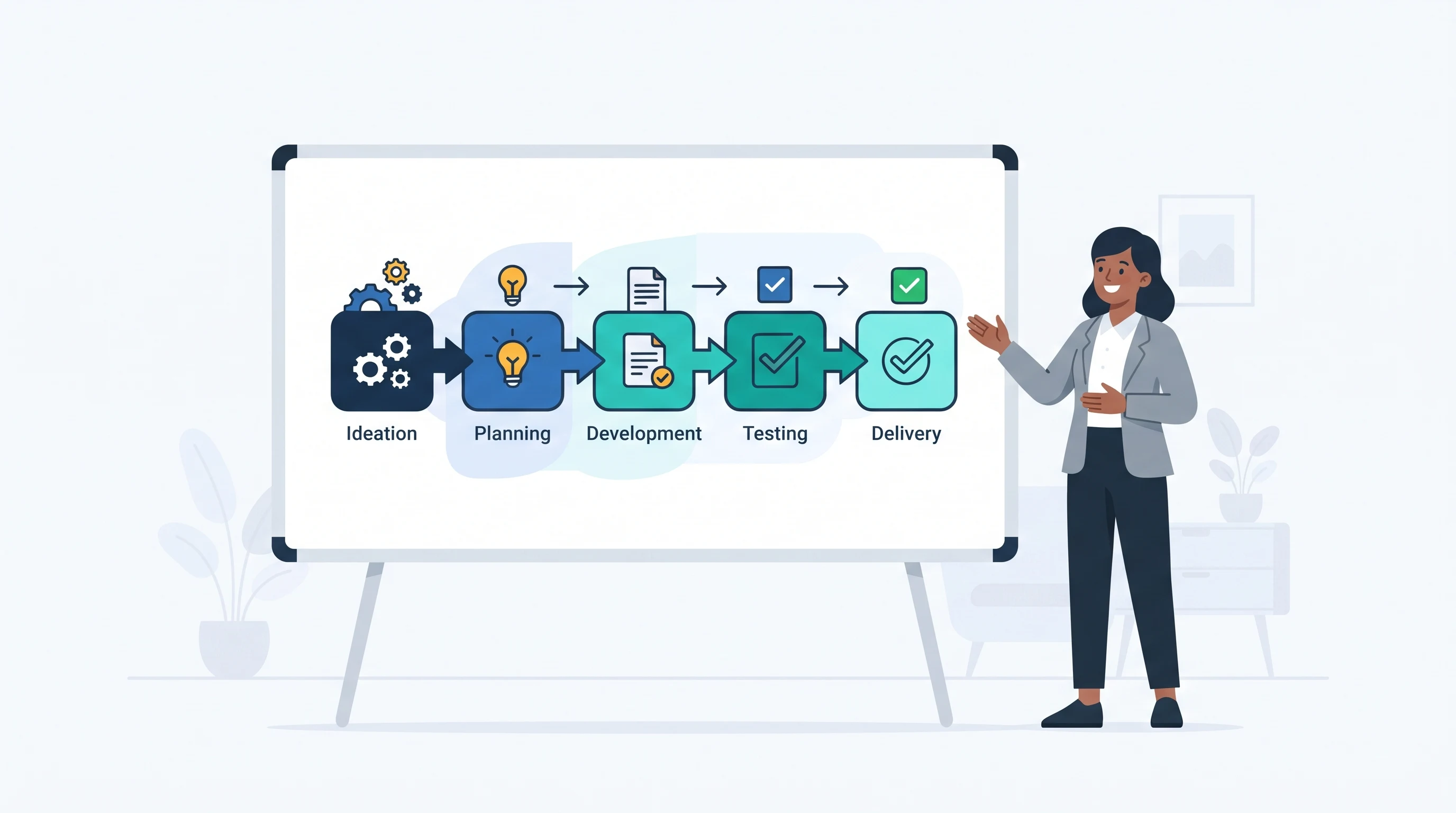
SAFe portfolio governance connects enterprise strategy to operational execution by governing the flow of value, funding epics, and validating hypotheses through Minimum Viable Products. Operating at the Lean Portfolio Management level, it ensures that the largest initiatives—those too substantial for a single Agile Release Train—are broken down, prioritized, and measured by business outcomes rather than output volume. Because SAFe is configurable and scalable, this governance model applies equally to small portfolios and the world’s largest enterprise ecosystems, giving senior leaders the predictable results and risk management they require while preserving the agility to respond to rapid market shifts.
In Short
What Is SAFe Portfolio Governance and Why It Matters
SAFe portfolio governance is the set of practices, policies, and decision rights that guide how an enterprise invests in and oversees its largest bodies of work. It sits within Lean Portfolio Management and answers a critical question: how do we fund and manage initiatives that span multiple value streams and Agile Release Trains without reverting to command-and-control micromanagement?
The underlying reality for senior leaders is that they must manage risk appropriately to deliver predictable results, while also recognizing that change happens rapidly—new technologies arrive, competitors shift strategies, and market tastes evolve. SAFe resolves this tension by embedding governance into flow. Instead of annual project mandates handed down from a steering committee, governance becomes a continuous activity visible on Portfolio Kanban boards, where epics move through defined states from funnel to done.
Because SAFe is configurable and scalable, this governance model adapts to the needs of small team-of-team portfolios as well as the largest global enterprises. The framework’s own practitioners apply these same methods—Kanban boards, backlogs, and PI objectives—to run their business, reinforcing the principle that governance is not a bureaucratic checkpoint but a learning system.
How Portfolio Flow, Epics, and MVPs Work Together
Effective SAFe portfolio governance rests on three integrated pillars. Each pillar answers a specific governance question: Are we investing in the right things? Can we deliver them predictably? And are we achieving real value?
Portfolio Flow
Portfolio flow ensures that initiatives move through the system at a sustainable pace, limited by capacity rather than wishful thinking. The Portfolio Kanban is the primary tool. By visualizing all potential and active epics, setting work-in-progress limits, and establishing clear policies for moving items forward, leaders make queueing and prioritization transparent. This directly supports the governance mandate for predictability: when work is visible and limited, bottlenecks surface early and funding decisions become data-informed rather than politically driven.SAFe Epics
Epics are substantial initiatives that cut across value streams and require significant investment. In SAFe, an epic is not merely a large requirement; it is a container for a hypothesis. Before an epic is approved, the organization develops a Lean Business Case that articulates the problem, the proposed solution, the expected business outcomes, and the development cost estimate. The Portfolio Backlog holds epics awaiting prioritization. Approval is not a one-time gate but a commitment to fund the next increment of learning.Minimum Viable Products (MVPs)
The MVP is the instrument of validation within SAFe portfolio governance. Rather than funding an epic’s full scope upfront, the portfolio funds an MVP designed to test the epic’s core hypothesis with the smallest possible investment. If the MVP demonstrates measurable value, additional funding is released for further development; if not, the organization pivots or stops, preserving capital and reducing risk. This practice embodies the learning mindset that Scaled Agile cites as central to its own success: governance becomes a mechanism for disciplined experimentation, not just control.SAFe Governance vs. Traditional Program Governance
| Dimension | Traditional Portfolio Governance | SAFe Portfolio Governance |
|---|---|---|
| Primary focus | Scope, schedule, and budget compliance | Business outcomes and validated learning |
| Funding model | Project-based annual budgets | Value stream-based, dynamic allocation |
| Decision cadence | Stage-gate reviews and steering committees | Continuous flow via Portfolio Kanban |
| Epic definition | Monolithic specification approved upfront | Hypothesis-driven Lean Business Case |
| Risk management | Centralized change control boards | Decentralized, validated through MVPs and feedback loops |
| Adaptability | Change treated as exception requiring re-baseline | Change expected; pivots guided by objective data |
| Scale | Often rigid; one-size-fits-all templates | Configurable and scalable from small portfolios to global enterprises |
How to Implement SAFe Portfolio Governance in Practice
Moving from theory to operation requires deliberate steps. The following approach aligns with SAFe’s established Lean Portfolio Management practices and the governance imperatives described in the reference context.
Key Takeaways
Frequently Asked Questions
What is the role of an MVP in SAFe portfolio governance?
An MVP is the smallest increment of an epic that can be built to test a business hypothesis with real users or systems. It acts as a controlled investment checkpoint, allowing the portfolio to validate value and reduce risk before committing additional funding to full epic implementation.How does portfolio flow differ from team-level flow in SAFe?
Portfolio flow operates at the highest level of the framework, governing how epics and large initiatives move through the Portfolio Kanban across value streams. Team-level flow concerns how features and stories move through team and program backlogs. Portfolio flow sets the strategic pace and investment priorities that shape the work feeding downstream.Who approves epics in SAFe portfolio governance?
Epics are typically reviewed and approved by the Lean Portfolio Management function, often represented by Epic Owners and key stakeholders. Approval is based on the Lean Business Case and portfolio strategic themes. Once approved, epics move to the Portfolio Backlog and are sequenced for implementation by Agile Release Trains.What is the difference between an epic and a capability in SAFe governance?
An epic is a large initiative that crosses value streams and requires substantial portfolio-level investment and governance. A capability is a higher-level solution behavior large enough to span multiple ARTs but is typically managed at the Large Solution level. Epics are portfolio governance artifacts; capabilities are solution architecture and planning artifacts.How can an organization balance governance requirements with agile flexibility?
Balance is achieved by shifting from compliance-based, upfront approval to outcome-based, incremental funding. By using MVPs, WIP-limited Kanban systems, and objective metrics, governance provides guardrails without prescribing execution details. This lets teams remain agile while giving leaders the predictability and risk management they need.What is the first step to improving SAFe portfolio governance?
Start by visualizing all portfolio-level work on a Portfolio Kanban and enforcing work-in-progress limits. Visibility is the prerequisite for every other governance improvement: without it, prioritization is guesswork and flow cannot be managed.Conclusion
SAFe portfolio governance succeeds when it is treated not as a control mechanism but as a value-delivery system. By governing flow, framing epics as hypotheses, and validating them through MVPs, enterprises give senior leaders the predictability and risk management they require while empowering teams to adapt rapidly. If you are unsure where your organization stands, take MaturaScore’s free maturity diagnostic to assess your current portfolio governance capabilities and receive an AI-assisted, human-validated action plan tailored to your context.