
If your team is debating **Scrum vs Kanban vs Scrumban**, the short answer is: choose Scrum for structured, time-boxed product delivery with clear roles; choose Kanban for continuous, unpredictable wo…
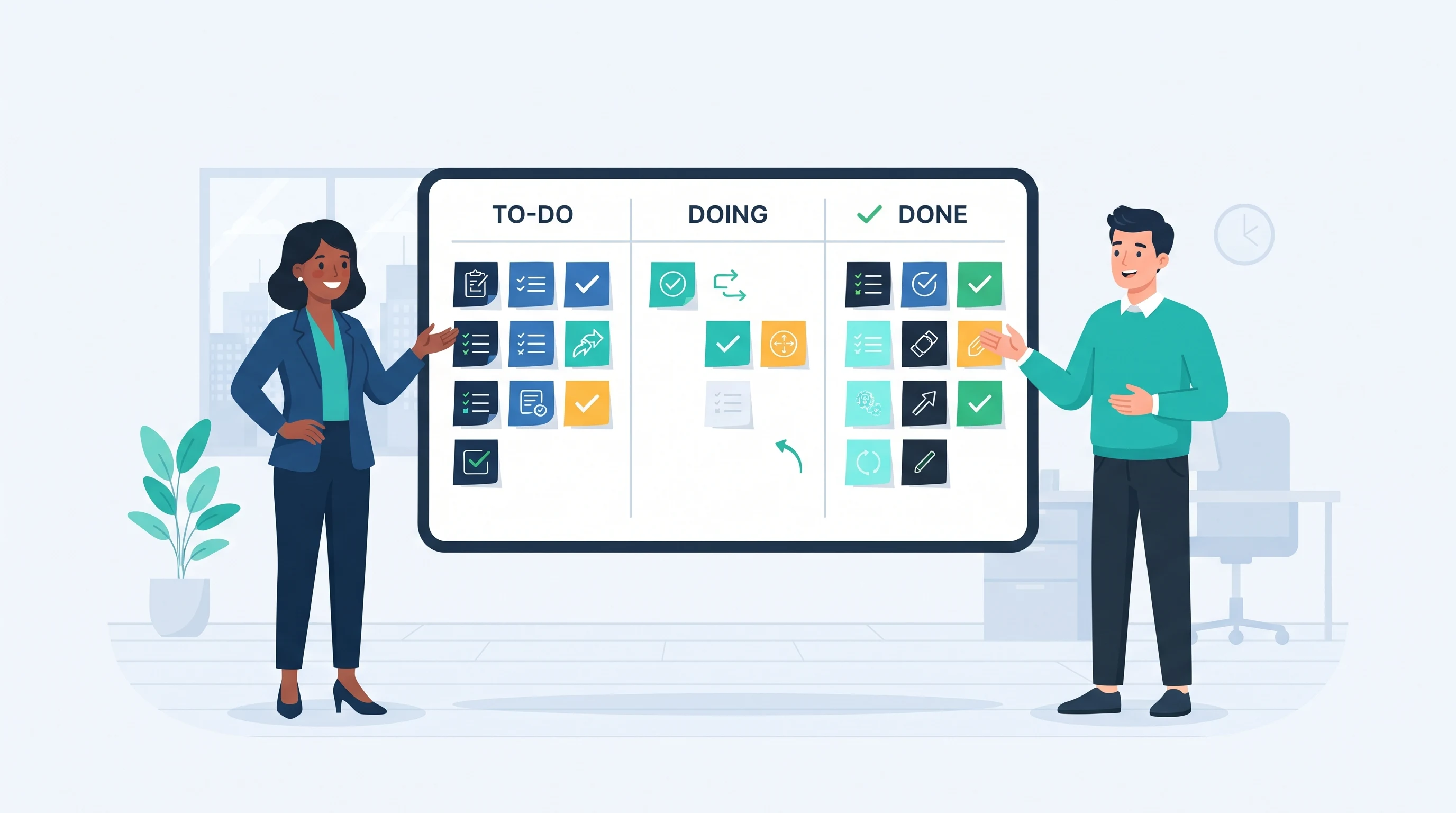
If your team is debating Scrum vs Kanban vs Scrumban, the short answer is: choose Scrum for structured, time-boxed product delivery with clear roles; choose Kanban for continuous, unpredictable work streams that need flow control; choose Scrumban when you already use Scrum but want to evolve toward Kanban’s pull-based flow without abandoning familiar rituals. Each approach applies the Agile Manifesto’s principles, but they differ sharply in cadence, rules, and the problems they solve best.
In Short
Understanding Scrum, Kanban, and Scrumban in Agile
Agile is a collection of practices and methods set out in the Agile Manifesto, built on cross-functional teams, self-organization, and collaboration. Scrum, Kanban, and Scrumban are three distinct ways teams operationalize those values.
Scrum: A Simple, Prescriptive Agile Framework
Scrum is the concrete framework used to implement Agile-based development. According to Forrester Research, approximately 90% of Agile teams use Scrum. Its popularity stems from the fact that it is not overly prescriptive but is a framework based on principles and values. Scrum consists of three roles—the Product Owner, the Scrum Master, and the Development Team—five events (the Sprint, Sprint Planning, the Daily Scrum, the Sprint Review, and the Sprint Retrospective), and three artifacts (the Product Backlog, the Sprint Backlog, and the Product Increment). Its core strength is simplicity: it focuses on a single team producing a single product, giving teams a regular rhythm to inspect and adapt.Kanban: Visual Flow and Work-in-Progress Limits
Kanban takes a different approach. Rather than boxing work into Sprints, it visualizes the entire workflow on a board and uses work-in-progress (WIP) limits to pull new items only when capacity allows. It prescribes no mandatory roles, ceremonies, or time boxes. Because of this, Kanban fits environments where demand is continuous and priorities shift frequently. Many practitioners have explored how Kanban fits with Scrum—the most widely used method at the team level—most notably in Henrik Kniberg and Mattias Skarin’s work Kanban and Scrum: Making the Most of Both (2010). That text emphasizes that Kanban is less a replacement for Scrum than a complementary system for managing flow and reducing context switching.Scrumban: Evolving Scrum Through Kanban Practices
The term “Scrumban” was first used in a book by Corey Ladas in 2009 (Scrumban), where he examined how applying Kanban to a team currently using Scrum might change standard practices of that method. In practice, Scrumban typically keeps Scrum’s team structure and some planning cadence while replacing or augmenting the Sprint container with Kanban’s continuous flow, WIP limits, and pull policies. It is not a rigidly defined framework; rather, it is an evolutionary path for teams that need more flexibility than pure Scrum allows but still benefit from its collaborative rituals. It is especially common in maintenance, research, and exploratory work where scope is emergent.Scrum vs Kanban vs Scrumban: A Side-by-Side Comparison
| Aspect | Scrum | Kanban | Scrumban |
|---|---|---|---|
| Core Structure | Time-boxed Sprints (fixed duration) | Continuous flow (no fixed iterations) | Hybrid: flow within optional Sprint boundaries |
| Roles | Product Owner, Scrum Master, Development Team | No prescribed roles | Often retains Scrum roles, but may evolve them |
| Key Events | Sprint Planning, Daily Scrum, Review, Retrospective | No mandatory events; optional replenishment & review | Selects Scrum events; adds flow reviews as needed |
| Work Limits | Scope fixed per Sprint; capacity via velocity | Strict WIP limits per workflow stage | WIP limits applied to board stages |
| Primary Metric | Velocity, Sprint burndown | Cycle time, throughput | Cycle time, CFD, flow efficiency |
| Best Suited For | Single team building a single product; predictable roadmaps | Maintenance, support, ops, unpredictable demand | Evolving teams; research, exploratory work |
| Origin/Authority | Defined in Scrum Guide; 90% of Agile teams use it | Rooted in Lean/TPS; Kniberg & Skarin (2010) detailed fit with Scrum | Coined by Corey Ladas (2009) as Scrum+Kanban evolution |
Common Pitfalls When Switching
Key Takeaways
Frequently Asked Questions
What is the main difference between Scrum and Kanban?
Scrum organizes work into fixed-length Sprints with defined roles, events, and artifacts, optimizing for regular inspection and adaptation. Kanban is a continuous flow system that uses a visual board and work-in-progress limits to pull work as capacity allows, prescribing no fixed roles or time boxes.When should a team use Scrumban?
A team should use Scrumban when it is already familiar with Scrum but needs greater flow and flexibility—such as handling frequent production support alongside feature development—without discarding the collaborative rituals that stakeholders expect.Is Scrumban officially defined in the Scrum Guide?
No. Scrumban is a community-driven evolution. Corey Ladas first used the term in his 2009 book Scrumban, describing how applying Kanban to a Scrum team might change standard Scrum practices. It is not an official Scrum.org or Scrum Alliance framework.Can a team switch from Scrum to Kanban?
Yes. Many teams evolve from Scrum to Kanban or to a Scrumban hybrid as their products mature and demand becomes more variable. Henrik Kniberg and Mattias Skarin’s 2010 text Kanban and Scrum: Making the Most of Both explores this transition in detail.Do you need a Scrum Master in Scrumban?
The Scrum Master role is quite specific in Scrum and provides specialized training to protect the process. In Scrumban, the role often evolves into a flow coach or Agile lead who focuses on WIP management and system improvement rather than strictly enforcing Sprint boundaries.Which framework is best for a startup?
If the startup is a single team building a single product with a defined roadmap, Scrum’s simplicity and focus make it a strong starting point. If the startup operates in continuous deployment or provides a live service with constant user feedback, Kanban or Scrumban may reduce unnecessary ceremony.Conclusion
Choosing between Scrum, Kanban, and Scrumban is less about finding the “best” framework and more about matching your team’s structure to the nature of its work. Start with the simplest approach that imposes useful constraints, then evolve. If you want an objective view of where your team stands today, try MaturaScore’s free maturity diagnostic—it assesses your current Agile operating model and generates an AI-assisted, human-validated action plan so you can improve with confidence, not guesswork.